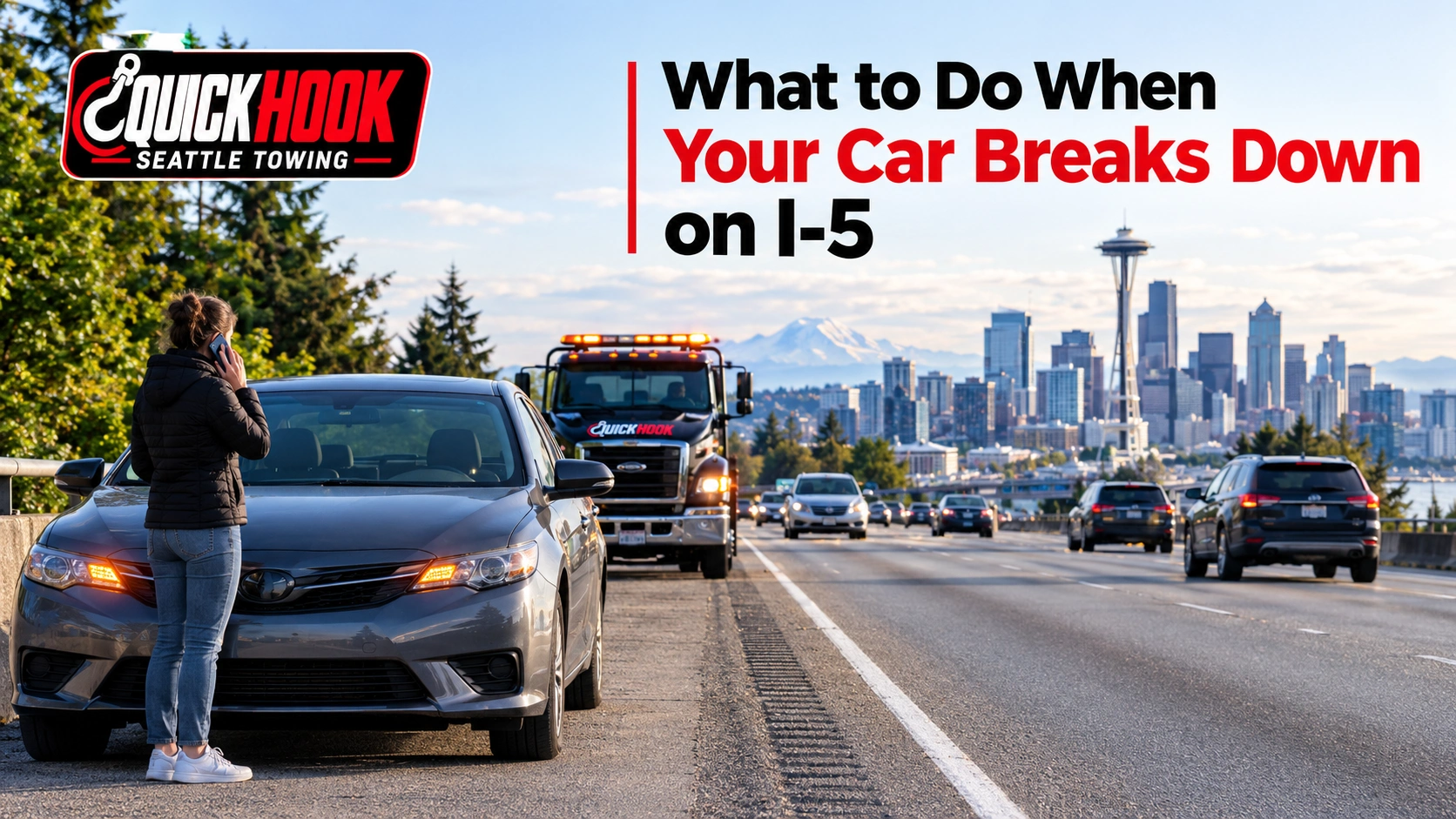
Quick answer: If your car breaks down on I-5 in Seattle, turn on your hazard lights, steer to the right shoulder, and stop as far from traffic as you can. Stay buckled in your car if you are away from the lanes. Call 911 if you are in danger, then call a tow company with your exact location.
A breakdown on I-5 is scary. Traffic is fast, lanes are tight, and the shoulder can be narrow, especially near downtown, the Ship Canal Bridge, and the I-90 and SR 520 interchanges. The good news is that a few calm steps make you much safer. This guide walks through exactly what to do, in order, so you know the plan before you ever need it.
If you need help right now, Quick Hook Seattle Towing offers 24/7 emergency towing. Call now: +1 (206) 608-8586
Step 1: Stay calm and turn on your hazard lights
The moment you feel the car losing power, hear a loud noise, or see a warning light, press your hazard lights. This tells drivers behind you that something is wrong before they reach you.
Then take a breath. Do not slam the brakes. Take your foot off the gas and let the car slow down on its own. If you lose power steering, the wheel will feel heavier. Grip it firmly and keep steering smoothly.
Step 2: Get as far from traffic as you can
Your goal is to get out of the travel lanes. Here is how to do that safely:
- Check your mirrors and signal to the right.
- Move toward the right shoulder. The right side is usually the safest place to stop.
- Use the left shoulder only if you have no other choice. AAA Washington notes that on a multi-lane highway with a median, the left shoulder can be used if there is plenty of room and you can’t reach the right one. See their guide to handling a breakdown.
- Take the next exit if you can reach it. An off-ramp or a surface street is often safer than a freeway shoulder.
- Stop in a straight section of road if possible, not on a curve or just past a hill where drivers can’t see you early.
- Turn your wheels away from the road and set the parking brake once you’ve stopped.
If you can’t leave the lane at all, keep your hazards on, stay buckled in, and call 911 right away. A stopped car in a live lane is an emergency.
Step 3: Should you stay in the car or get out?
This is the question most drivers ask, and the answer depends on where you stopped.
Stay in the car if you are safely on the shoulder. AAA Washington advises that if you are able to pull away from traffic, it is generally safest to remain inside your vehicle until help arrives. Keep your seat belt on and your hazard lights flashing.
Get out only if staying inside is more dangerous. That includes these situations:
- You are stuck in or right next to a travel lane
- You smell smoke or see flames
- You see fuel leaking
- You think another vehicle may hit you
If you must leave, exit on the side away from traffic. Move well off the road, behind a guardrail or up an embankment if you can. Never stand between your car and moving traffic, and don’t try to repair a tire or look under the hood on a busy freeway.
Step 4: Know when to call 911 and when to call a tow
Not every breakdown needs an emergency crew, but some do.
Call 911 if:
- Someone is hurt or feels sick
- Your car is blocking a lane or partly in traffic
- Your car is smoking or on fire
- You feel unsafe for any reason
Call a tow company if:
- Your car won’t start or has stalled and you are safely off the road
- You have a flat tire and no safe way to change it
- The engine overheated or a warning light came on and you can’t keep driving
- You ran out of fuel
- Your battery is dead and a jump start isn’t safe on the shoulder
In the Seattle area, the Washington State Department of Transportation runs Incident Response Teams that help clear disabled vehicles from the highway. A local tow company is still the fastest way to get your car moved and to a shop or home. Our emergency towing service is built for exactly this situation.
Step 5: Give the dispatcher your exact location
On a long freeway, “I’m on I-5 somewhere in Seattle” isn’t enough. The faster you describe where you are, the faster help can reach you. Look for:
- Direction of travel: northbound or southbound
- The nearest exit number or cross street: for example, the last exit you passed or the next one ahead
- Mile markers or green signs along the shoulder
- Landmarks: a bridge, an overpass, a stadium, or a large building
- Your car: make, model, color, and license plate
If your phone has location sharing, send your pin to the dispatcher or a friend. Also tell them if you are in a lane, on the shoulder, or on a ramp, because that changes how the truck approaches.
Step 6: Make yourself visible and wait safely
While you wait for the tow truck:
- Keep your hazard lights on, and turn on your dome light at night
- Keep your seat belt on
- Keep doors locked and windows up
- If someone you don’t know stops to help, stay in the car and ask them to call for help instead of opening the door
- Stay off the phone for anything but calling for help, so your battery lasts
Tell the dispatcher how many people are in the car, and whether anyone is a child, older, or needs medical attention.
What to expect from a safe, professional tow
When a tow truck arrives, a good company will make the pickup simple and clear. Before they hook up your car:
- Confirm the company name matches who you called
- Ask for the total price before the tow starts, including any extra fees
- Tell them where to take the car, whether that is your home, a mechanic, or a dealership
- Take photos of your car before it is loaded, in case you need them later
- Remove valuables and keep your keys and wallet with you
You can also ask whether your insurance or roadside plan covers the tow. Many do, so it’s worth a quick call or a check in your insurance app.
Remember the Move Over law, because it protects you too
Washington’s Move Over law protects people working or stopped on the side of the road. Under RCW 46.61.212, the Washington State Patrol says drivers approaching an emergency zone must move over one lane if it is safe, or slow down at least 10 miles per hour below the posted speed limit. The zone covers 200 feet before and after the vehicle. The law also covers tow trucks with flashing red or amber lights.
When your tow truck arrives on I-5, other drivers are required to give the driver and your vehicle that extra space. If you have to step out to meet the driver, stay close to the truck and follow their directions.
Was it a minor crash, not just a breakdown?
If your car stopped because of a small collision and nobody is hurt, Washington’s “Steer It, Clear It” rule applies. According to the City of Seattle’s rack card, state law requires you to move your vehicle off the roadway in a non-injury crash if it is drivable and safe to move. If anyone is hurt, call 911 and don’t move the vehicle unless it’s necessary for safety. You can also report a collision online with the Washington State Patrol.
Keep a breakdown kit in your car
A few simple items can make a long wait on the shoulder safer and more comfortable:
- Phone charger or power bank
- Flashlight with fresh batteries
- Reflective vest
- Warning triangles or flares
- Water and snacks
- Blanket and warm layers (Seattle weather can turn fast)
- First aid kit
- Your insurance and roadside assistance card
Also save a tow company’s number in your phone before you need it. If you want help with other problems, see our guides on jump starts and battery help, flat tire changes, and lockout service.
Stuck on I-5 right now? Quick Hook is ready to help
A breakdown is stressful, but you don’t have to handle it alone. Quick Hook Seattle Towing is here day and night for drivers across Seattle and I-5. Tell us where you are, and we’ll get a truck headed your way.
Call now for 24/7 emergency towing: [PHONE NUMBER]
Frequently Asked Questions
What should I do first if my car breaks down on I-5 in Seattle?
Turn on your hazard lights, ease off the gas, and steer toward the right shoulder. Stop as far from traffic as possible, set the parking brake, and call for help. Call 911 if you’re in a lane, hurt, or feel unsafe.
Is it safer to stay in the car or get out on the freeway?
If you are safely on the shoulder, staying in the car with your seat belt on is generally safest. Get out only if you are in a travel lane, see smoke or fire, or think another car may hit you. Exit on the side away from traffic.
Who do I call when my car breaks down on I-5?
Call 911 if you are blocking a lane, someone is injured, or the car is on fire. For a stalled, flat, or dead-battery vehicle that is safely off the road, call a local tow company like Quick Hook and give them your exact location.
How do I tell a tow company where I am on the freeway?
Share your direction of travel, the nearest exit number or cross street, any mile marker you can see, and nearby landmarks. Sending your phone’s location pin helps a lot too.
Can I fix my car on the side of I-5?
It’s best not to. Changing a tire or looking under the hood next to fast traffic is dangerous. Stay safe and let a professional handle it.
What should I ask a tow company before they take my car?
Ask for the company name, the total price, and where they will take the vehicle. Confirm all of this before they hook up your car.
Does Washington law protect tow truck drivers on the highway?
Yes. Under the Move Over law (RCW 46.61.212), drivers must move over one lane when safe, or slow down at least 10 mph under the speed limit, when passing a tow truck with flashing lights or other emergency vehicles.